A leaf landed on the surface of a pond. Small waves circled outward like a rose unfolding. Fish nibbled at it. Wind, like a giant finger moved it gently across the smooth surface pressed between water and sky. Slowly, after days, it sank in pieces. Some larger, some smaller, drifting silently to the muddy floor. Only a leaf in a quiet pond on a clear day. The smallest change yet still occurred still felt and by me not unnoticed.
I started this blog a couple of years ago as a way to tell the story of our migration from Santa Fe, NM to Beacon, NY. I didn't get very far with that, but here's another little installment.
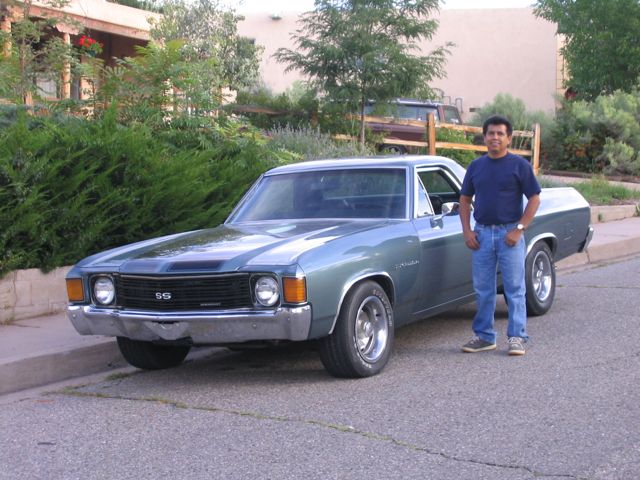
Literally the day we left, while we were cramming the last of our belongings into our cars, Jose came by to show us the wonders he had worked with Moby, the 1972 El Camino he had bought from me earlier in the year. Now a SuperSport (upgraded from a 350 to a 396 engine), beautifully restored (and no longer white, thus no longer befitting the name I had originally bestowed), I knew she was in good hands.
Ah, the yellow and beige food for the weary traveler...
Beacon, New York
Knowing we'd never do it after we arrived, we had the house "gutted" (awful, awful term) while we were still in Santa Fe. We pulled in to Beacon in late August, on a sunny and not too humid afternoon, unloaded the dogs, houseplants, and other essentials.
The kitchen on arrival day.
The kitchen, slightly domesticated. Can't believe I washed dishes in that sink for over 2 years.
The moving truck arrived the next day (or was it two days later?). James pores over our new surroundings.
Tuesday, November 23, 2010
From the Enid Haupt Glass Garden at the Rusk Institute of Rehabilitative Medicine. Most of the pictures I took on this day were of the garden, but this green hose caught my eye.
I've recently learned that the Glass Garden and its wonderful horticultural therapy program are slated to be dismantled to make room for more buildings (and no, no plans to put them back somewhere else, even though there are other courtyards on the campus). This would be a true tragedy.
My friend Mike gave me a first-hand account of his experience as a patient there when he suffered a traumatic brain injury. For him, the garden offered a reason to live, a life raft for a drowning man. You can read the full story, A Life Worth Living: The Garden as Healer, on the Therapeutic Landscapes Network Blog.
My favorite fun facts from the recent NYT book review by Beverly Gage about Jeffrey Owen Jones' The Pledge: The History of the Pledge of Allegiance:
The original salute, written by Francis Bellamy in 1892, was
"I pledge allegiance to my flag and to the republic for which it stands--one nation indivisible--with liberty and justice for all."
Gage writes, "In the 1920s, patriotic groups like the American Legion campaigned to change 'my flag' to 'the flag of the United States of America,' anxious that immigrant children might secretly be pledging to the flags of their original homelands. Three decades later, Congress added the words 'under god' to distinguish American patriotism from 'godless Communism'..." I never did feel comfortable with that whole under god thing. Whatever happened to separation of church and state?
Another fun fact: The original pledge posture was not hand over heart, but hand held straight out in a salute, "a gesture that mysteriously began to lose popularity in the 1930s."
Maybe it's time to post fewer pictures on Facebook and more here on my little neglected blog. I don't get to share the stranger pictures on the Therapeutic Landscapes Network Blog because they're just a little too...strange. But to me, beautiful nonetheless, or perhaps just interesting in a way that "pretty" isn't.
Hamamelis virginiana, Stonecrop Gardens
Milkweed pods and seeds
All photos are (obviously) by me, Naomi Sachs. If you steal them, I won't be happy, so don't.
I love my fair city of Beacon, NY, but sometimes our little local newspaper, the Beacon Free Press, gets me down. This week, the garden column featured a long article about the benefits of the herbicide Roundup. This mentality elicits in me a combination of sadness and anger. 'I don't have time to respond to this, just let it go,' I thought, but here I am, several hours later, with a draft of the letter I'm going to send to the Beacon Free Press, with fingers crossed that they'll print it in full. As an aside, this is also a testament to Facebook and Twitter. When I did decide to write something, I put the word out in both places for help with building my case. Within 24 hours I had received over ten responses, more than enough for me to write my letter with solid research rather than just my own personal feelings. So, here it is. Feel free to share and comment!
Think twice (and hard) before using Roundup
I would like to respond to Mark Adams’ “Get Growing” column from August 4th (“Special advice for dealing with overwhelming weeding issues”). Roundup is a poison. That's how it kills weeds! This herbicide is harmful to animals (including us), to our groundwater, and even to our gardens (more on this in a minute). Monsanto claims that Roundup is "as safe as table salt," but there is plenty of evidence to the contrary.
The active ingredient in Roundup is glyphosate, which has been found to be toxic to animals, including humans. Noticeable symptoms include eye and skin irritation, headache, nausea, numbness, elevated blood pressure, and heart palpitations. But wait, there’s more!
A new study in the respected journal Toxicology has shown that, at low levels that are currently legal on our food, Roundup could cause DNA damage, endocrine disruption and cell death (specifically embryonic, placental, and umbilical cord cells). The study shows that glyphosate-based herbicides are toxic to human reproductive cells. The potential real-life risks from this are infertility, low sperm count, and prostate or testicular cancer (so make sure to get yourself tested annually, Mr. Adams!). Exposure is associated with an increased risk of miscarriages, premature birth, and the cancer non-Hodgkin's lymphoma. Recent studies have also found that Roundup’s inert ingredients – solvents, preservatives, and surfactants - are hazardous when combined with glyphosate. In other words, Roundup’s inert ingredients amplify its active ingredient’s toxic effect, especially at the cellular level.
Even New York State’s Attorney General isn’t so sure about Roundup. They sued Monsanto for claiming that the herbicide is "safe" and "environmentally friendly."This suit ended in a settlement, with Monsanto agreeing to cease and desist from using these terms to advertise Roundup in our state.Although Monsanto did not admit to any wrongdoing, they paid the state of New York $250,000 in settlement of this suit.When Monsanto violated the first settlement agreement by advertising within New York that Roundup is "safe," a second agreement was negotiated (see http://www.naturescountrystore.com/roundup/index.html).
Roundup, especially when used regularly, in large quantities, or incorrectly, is harmful to humans and to pets, to wildlife, to our groundwater, and even to our gardens! Yes, Roundup changes the pH of the soil, kills earthworms, and makes the plants we do want (flowers, shrubs, vegetables, etc.) less resistant to diseases and pests.
As both a landscape designer and an avid gardener, I understand the frustration with weeds growing where you don't want them.Roundup is, indeed, an effective herbicide, but especially for home gardeners who may not be aware of its harmful effects and best practices when applying, I urge people to err on the side of safety first. Weeding is just another part of gardening (and it’s good exercise!); mulch makes an effective weed barrier while also nourishing soil and keeping plants from drying out; white vinegar applied to weeds is a much less toxic solution. These are just a few of the many safer alternatives (for more, see http://www.beyondpesticides.org). Your family, your pets, the birds and butterflies, the water you drink, and your neighbors will all thank you!